
How to stop exam paper leaks with a secure online exam
How to secure exams against paper leaks: a blueprint for an online exam, run on locked-down terminals in supervised centers, that removes the single paper, stays locked until the start, and makes any leak traceable.
Short answer: to secure an exam against paper leaks, move it online, onto locked-down computers inside supervised exam centers (not a test taken at home), and build it on three rules. There is no single paper to steal, because every candidate gets a different form from a large question bank. Nothing is readable before the exam, because the content stays encrypted and the key is released only at the start. Every copy is traceable, because each candidate's form carries a hidden watermark and bots watch for leaks. Blockchain sits on top as a tamper-evident record that proves nobody swapped anything. It is the CCTV, not the lock.
I build production web and Web3 systems, and exam paper leaks are the kind of problem I like: part physical, part human, part cryptography. At its core it is an exam-security problem, and this is the blueprint I would build to secure an exam end to end. Treat it as a design, not a shipped product.
A leak is a failure of secrecy, not of record-keeping. Fix secrecy first, then prove it with a ledger.
Why do exam papers leak in the first place?
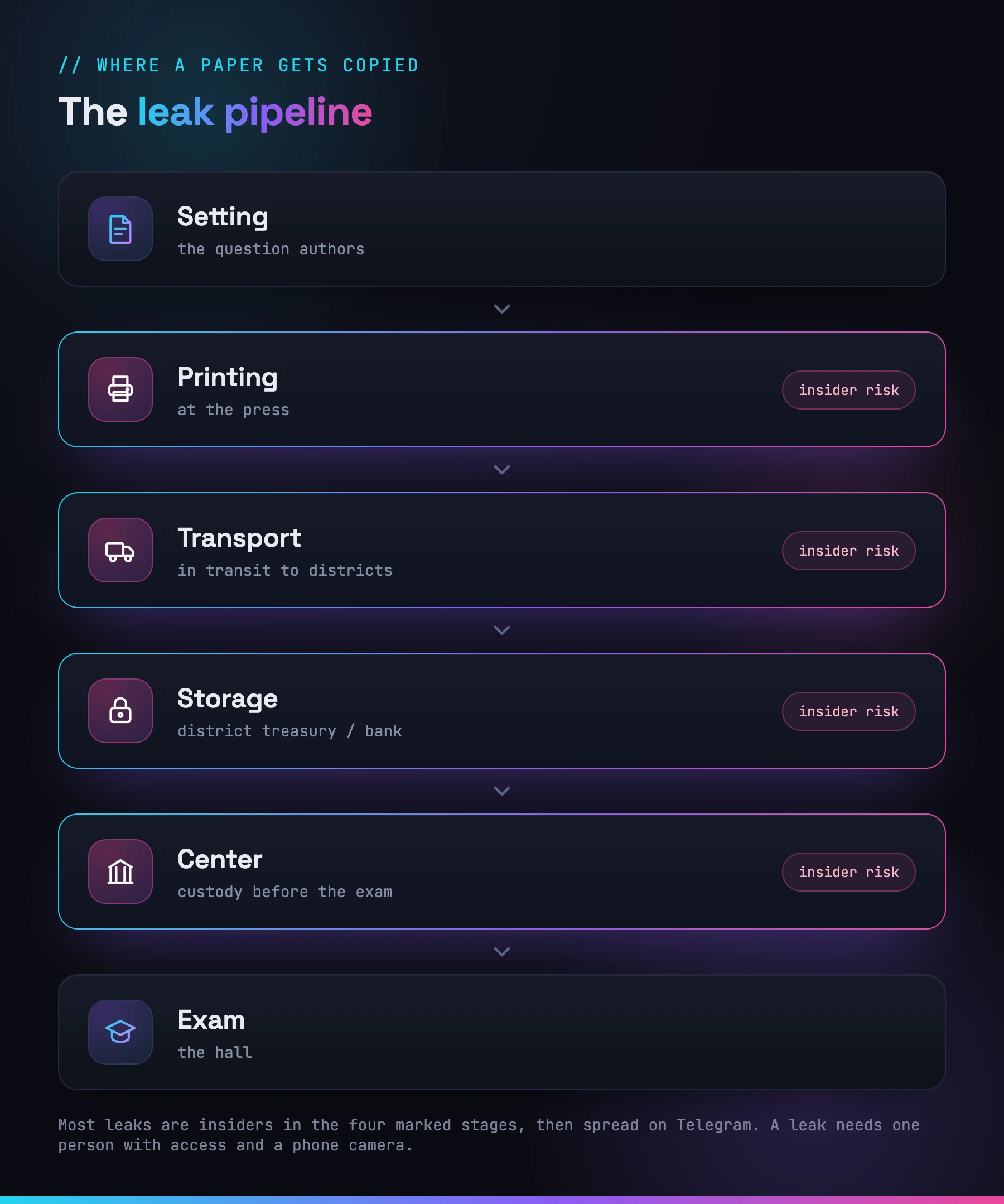
Because a paper passes through many hands before a student sees it, and any hand can copy it. The pipeline is long: setting, moderation, printing, transport, district storage, center custody, and finally the hall. Every handoff is a person, and every person is a possible leak.
In India, question paper leaks hit high-stakes exams like NEET, JEE, SSC, and state board exams. The break is usually at the press, a storage point, or a center, and the content then spreads on Telegram and WhatsApp shortly before the exam. The tool that leaks it is a phone camera. Any fix that ignores that is solving the wrong problem. So the real goal is simple to state: the thing an insider can photograph must be worthless, non-existent, or a signed confession.
Does moving the exam online fix it?
Mostly, and it is the biggest single win, but online alone is not enough. Going online (computer-based testing, or CBT) deletes the entire physical chain: no press, no transport, no district storage, no printed bundles sitting in a room. That chain is where most leaks happen, so removing it removes most of the risk.
Online does not mean at home. It means computer-based testing on locked-down terminals inside supervised exam centers, with biometric check-in and proctoring. The moment an exam runs somewhere you do not control, a phone camera and a stand-in undo everything, so the supervised center stays. What going online removes is the vulnerable paper supply chain, not the supervision.
But it moves the risk, it does not erase it. New weak points appear: the paper sitting in plaintext on a server, the admin who can read it, whoever holds the decryption key, and a candidate photographing the screen. So online is the platform. The next three sections are what you build on it.
How do you make sure there's no single paper to steal?
Stop having one paper. Give every candidate a different form, assembled from a large, pre-approved question bank. When there is no single canonical paper, there is nothing monolithic to leak, and a leaked question is one of thousands, low value and easy to retire.
The hard part is fairness, not generation. Two forms must be equally hard, or you have swapped a leak problem for an injustice problem. This is standard psychometrics: Item Response Theory (IRT) calibrates each question's difficulty, and statistical equating makes different forms score the same. Form assembly is a constraint problem (coverage, difficulty, no repeats) solved with a solver, not by hand.
AI helps on the supply side: models draft and paraphrase large volumes of candidate questions and flag near-duplicates, so the bank stays big and fresh. Every generated item still passes human subject-matter review before it goes live. The model widens the funnel; it does not get the final say.
How do you keep the paper unreadable until the exam starts?
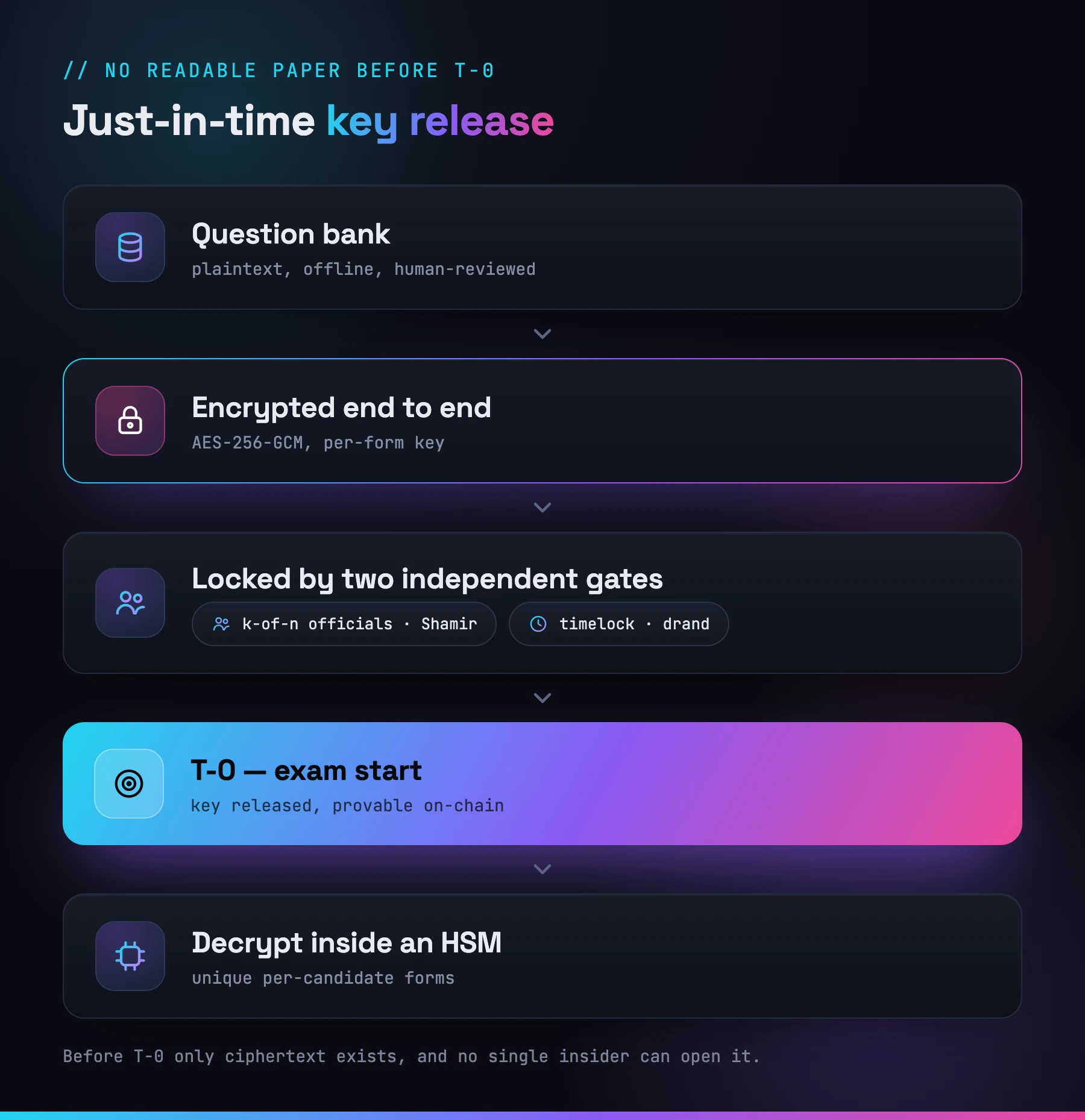
Encrypt it end to end, and release the key only at the start. If the only thing that exists before the exam is ciphertext, a leak before the exam reveals nothing. This is the core of the whole design, and it is pure cryptography.
- Encrypt the bank with AES-256-GCM; each form gets its own data key.
- Split the key with Shamir Secret Sharing so unlocking needs k of n officials, not one. One compromised insider is not enough.
- Time-lock it with a public randomness beacon like drand, so the content mathematically cannot decrypt before the exam window, with no single party holding the key.
- Decrypt inside hardware (an HSM or the terminal's TPM), never into a plain file an operator can copy. Either render on secure CBT terminals or print on-site minutes before.
How do you make a leak traceable?
Watermark every copy uniquely, and hunt for leaks automatically. If a form does escape, the goal shifts to attribution and speed: know exactly whose copy leaked, and find it fast enough to act inside the exam window.
Each candidate's form carries a hidden per-candidate watermark, encoded in question order, spacing, or benign wording variants. This is traitor tracing: a photographed screen points back to one seat, one center. Knowing the leak is signed changes insider behaviour more than any policy memo.
Detection is where AI does real work. Bots scan public Telegram channels, WhatsApp forwards, and social media, and match suspects against the live bank with perceptual hashing, which recognises an image even after cropping, re-photographing, or compression. On a confirmed hit the system rotates keys, retires affected questions, and hands investigators the watermark trace, in minutes rather than days.
What does blockchain actually add?
A tamper-evident, publicly verifiable record, and nothing more. Once secrecy is handled by cryptography, a ledger makes the process provable to people who do not trust the authority. That trust gap is real in high-stakes public exams, and it is exactly what a ledger is for.
Four things are worth putting on-chain:
- Bank commitment. A hash published before the exam proves the questions were fixed in advance, not swapped later.
- Key-release event. A timestamp of when the key opened and which k of n officials authorised it.
- Per-candidate assignment. A Merkle root over which form each seat received, auditable without revealing the mapping.
- Chain of custody. Each handoff signed by the receiver, so any gap is visible to everyone.
None of this keeps a secret. All of it makes tampering after the fact impossible to hide. Immutable is not the same as secret, and confusing the two is the most common mistake here.
What does a leak-proof exam look like for a student?
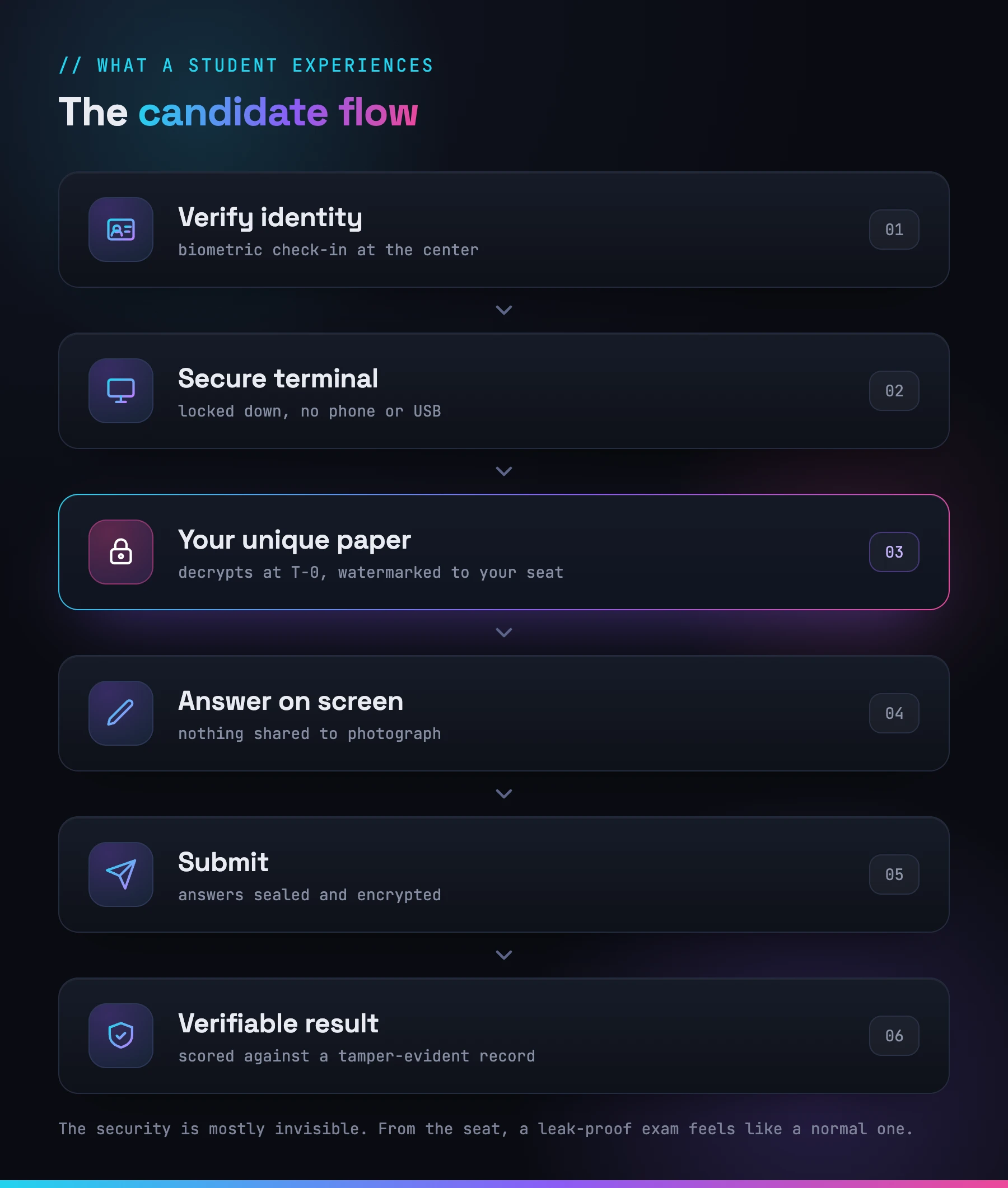
From the seat it barely changes. A candidate verifies who they are, sits at a locked-down terminal, and at the start their own unique paper appears on screen, watermarked to them. They answer, submit, and the result is scored against a tamper-evident record. The security is mostly invisible, which is the whole point.
What would make this hard in the real world?
The cryptography is the easy part. The failure modes are operational and political, and being honest about them is the difference between a blueprint and a fantasy.
- Connectivity. Just-in-time keys and CBT assume reliable networks. Rural centers do not have them, so you need offline-capable key delivery on tamper-evident devices and a safe fallback.
- Cost and scale. CBT for tens of millions of candidates needs enormous secure infrastructure. Phased rollout by exam and region is the only realistic path.
- Impersonation. A stand-in sitting the exam is a different problem, solved with biometric check-in and proctoring. It is also why the exam runs at a supervised center, never at home.
- Procurement and politics. Public exam systems are bought slowly and run by many agencies. The best design still has to start as a pilot beside the current process, not replace it on day one.
Key takeaways
- Paper leaks are a secrecy and access-control problem, so cryptography is the core fix and blockchain is only the audit layer.
- Online (CBT) deletes the physical supply chain, which is the single biggest source of leaks, and enables per-candidate forms.
- Build on three rules: no single paper, nothing readable before the start, every copy traceable.
- The hardest problems are connectivity, cost, and procurement, not the algorithms.
Questions you might have next
- Does this need a public blockchain? No. A permissioned ledger works for the audit trail. A public chain mainly adds outside verifiability, which can help public trust.
- Is CBT mandatory? No, but it shrinks the readable-paper window the most. On-site printing from a just-decrypted file is the pen-and-paper equivalent.
- Can AI alone catch every leak? No. Detection reduces the damage window; it does not prevent the leak. Prevention comes from encryption and the missing single paper.